


2.5/5
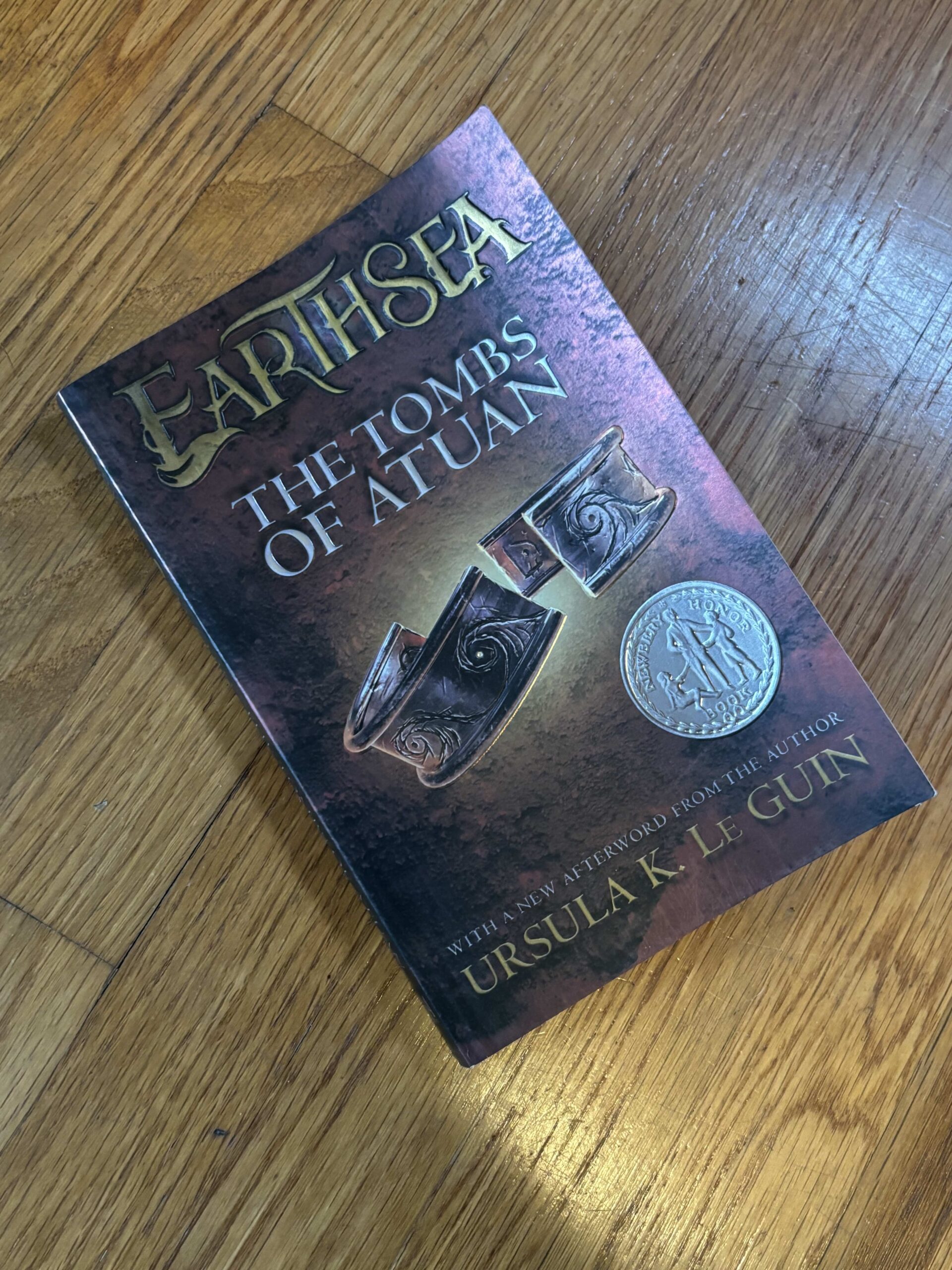
The Tombs of Atuan, the sequel to A Wizard of Earthsea, delivers a far more interesting premise, plot, and set of characters than the first novel, but still falls short from being a personal favorite.
Tenar is born on the same day that the High Priestess of Atuan dies, marking her as the new High Priestess – a role she assumes on her sixth birthday. She becomes Arha, or the “Eaten One.” Everyone knows that she is the same eternal High Priestess of past lifetimes, simply in her newest reincarnation. Arha’s life is dedicated to the unseen Dark Ones and she spends her time learning sacred rites and preparing for her role as High Priestess. Her life exists entirely within an isolated compound of holy places where other priestesses and eunuchs reside. She knows she is terribly important and powerful, and she is well aware that she possesses privileges that are unique to her, such as special access to the labyrinth where no light is permitted and where she alone can go.
As Arha grows in maturity and responsibility, her duties and relationships with those around her evolve. She is prideful, selfish and temperamental, causing hardship for those around her. Manan, the eunuch who has looked after her and in fact helped identify her as the High Priestess before she became Arha, has a special relationship with her. Then one day everything changes when Arha discovers a strange man in the labyrinth – Sparrowhawk, or the wizard Ged from Earthsea.
This world was interesting in concept, though dull to read about at times. I liked that we entered the world of the Kargs who were considered the enemy in the first book. Here they operate by a different set of belief systems. Wizardry is seen as a weird and shallow perversion of true magic; the Kargs hold sacred the deeper, more primal powers of older magical forces. Reading is considered evil, so illiteracy is the norm. And the Kargs are deeply xenophobic, choosing isolation and coming into contact with other peoples only when they fight or raid their lands (which is how we were first introduced to them at the beginning of The Wizard of Earthsea).
Best parts
Perspective shift
I loved that Le Guin turned everything around and gave us a completely different perspective in The Tombs of Atuan compared to what we know of the Earthsea universe from the previous book. We got to see the life and beliefs of characters previously seen as the enemy and develop some compassion and understanding for those we villainized a book ago, practicing some perspective-switching. We also get to enjoy reading about a female protagonist in a majority-female community.
Character relationships
The character relationships drew me in! Loved the tension between Arha and Kossil, and the strangely tender relationship she has with Thar and especially Manan. Arha reminded me a little bit of Colin Craven and Mary Lennox from The Secret Garden – they’re all a little spoiled and selfish, holding power over those who serve them, yet in some ways still deferential to their servants – so this made the character dynamics more interesting and believable.
Plot
I gotta say, it was a good plot! Things definitely moved slowly – I think that’s just Le Guin’s pacing as a writer, now that I know her from two books – but the bones, as in the first book, are not bad. Things start to get interesting when Arha discovers Ged in the labyrinth and escalate nicely as Kossil finds out about their secret meetings. The end felt rushed and left a lot to be desired, but it was a still gratifying to think about the story after finishing it.
Worst parts
Manan’s fate
They did Manan dirty at the end. I expected a little more on this. He was a big character – I got attached to him – then he meets his end so abruptly and unceremoniously. Sure, I can accept that happening even if I don’t like it. But for Tenar to basically have zero processing after he was her closest confidante throughout her entire life as Arha? It felt empty and I wish we’d gotten just a couple more lines on Tenar’s response to Manan’s death.
Writing
Le Guin’s writing is just not my favorite. This is honestly just a matter of taste. I like reading Joan Didion, Octavia E. Butler, Philip Pullman. Le Guin doesn’t write like any of them, which is not objectively good or bad – just different – and I can accept that. But her writing style is the biggest reason I give this book such a low rating.
Final Thoughts
At the end of the day I didn’t really enjoy reading The Tombs of Atuan and I don’t feel compelled to ready any more books from this series. My next Ursula K. Le Guin read will be The Left Hand of Darkness because that’s the book everyone talks about.
Another lesson (reminder?) on reading authors who are new to me: I’m going to start with their best known work first, then go deeper into their catalogs only if I liked it. This is how I read Octavia E. Butler. I started with The Parable of the Sower (5/5, instant classic, one of my absolute favorites). Then moved onto The Parable of the Talents (another 5/5). Then Kindred (dare I say… another 5/5).
No more plowing through bad books.
Life’s too short and my TBR’s too long 😂
What do you think? If you’ve read The Tombs of Atuan, what was your take on it? Did I totally miss the point? What do you recommend instead? Let me know in the comments 🙏
Pin this post
Leave a Reply